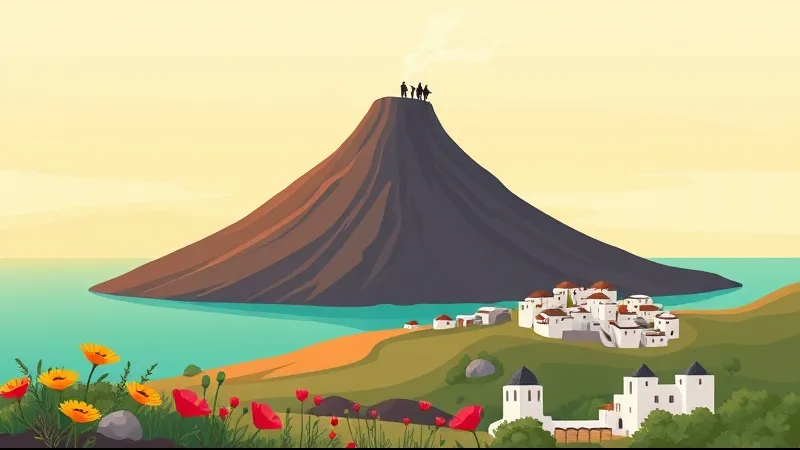
Stromboli in Spring: The Best Season for Volcano Trekking
Why April to June offers the ideal conditions to hike one of the world's most active volcanoes
Any prices mentioned below are indicative planning figures, not quotes for your travel dates. Check the current total, inclusions and conditions with the provider.
Why is spring the best season to trek Stromboli?
Spring can offer mild days and flowering vegetation, but it does not guarantee stable weather, operating ferries or open paths. Check the forecast, carrier notices and municipal restrictions for your actual travel dates.
Stromboli is part of the Aeolian Islands, a UNESCO World Heritage Site since 2000, and is one of the very few volcanoes on Earth with continuous, mild Strombolian activity — short explosive bursts every few minutes, visible from sea level. Its behavior is monitored in real time by the INGV — Osservatorio Etneo, which publishes weekly multidisciplinary bulletins. Spring's mild weather aligns perfectly with the authorized access windows, making it the sweet spot between winter's rough seas and summer's oppressive heat.
What is the weather like on Stromboli in spring?
Spring weather on Stromboli is defined by the Mediterranean climate of the southern Tyrrhenian Sea: gentle, dry, and increasingly stable as the season progresses.
- April: Average highs of 17–19°C, occasional light showers, sea temperature around 16°C. Winds can still be lively, especially from the north-west.
- May: Highs of 20–23°C, very little rainfall, sea warming up to 18°C. Arguably the most balanced month for hiking.
- June: Highs of 24–27°C, almost no rain, sea at 20°C and swimmable, longer daylight for sunset-timed ascents.
Seasonal averages do not certify conditions for a particular trek. Heat, wind, rain and rough seas can affect a spring visit too; consult dated forecasts and the operator before departure.
How high can you legally hike on Stromboli?
Access is regulated by municipal ordinances. The following refers to Lipari ordinance no. 16 of 5 May 2025; check for later restrictions before departure.
- Stromboli side: unguided access up to 290 m only via Strada vicinale Parroco and Mulattiera Salvatore di Losa.
- Guided access: authorized guides are required between 290 and 400 m on the Stromboli side. From Ginostra, the ordinance allows unguided access to 130 m and guided access to Punta dei Corvi at 400 m.
- Summit: not authorized by this ordinance. The Sentiero Natura is also closed pending restoration.
Because limits are revised after significant eruptive events, always check the Comune di Lipari official website and the latest INGV bulletin a few days before travel. Rules can change within hours, and fines for unauthorized hikers above the free-access zone are steep.
Do you need a licensed guide to climb Stromboli?
Use an authorized guide where required by the ordinance. Professional preparation helps manage the excursion but cannot eliminate sudden volcanic hazards.
Typical prices you can expect:
- Guided hike to Punta Labronzo / sunset viewpoint (around 290 m): from €30 per person.
- Guided ascent to authorized higher altitudes: usually €50 to €80 per person, depending on the current accessible level and group size.
Before booking, verify credentials on the registers of the Collegio Regionale Guide Alpine Siciliane. A proper guide will carry helmets, first aid, emergency lights, and a radio — if any of these are missing, that's a red flag. For a full comparison of the trekking options from the island, see our guide to choosing the right Stromboli excursion.
What makes Stromboli unique among active volcanoes?
Stromboli is the namesake of an entire eruptive style. Strombolian activity — short, rhythmic explosions ejecting incandescent lava bombs a few dozen metres into the air — has been documented in continuous form for at least 2,000 years, making Stromboli the longest-erupting volcano in the Mediterranean and earning it the nickname "Lighthouse of the Mediterranean".
Its most striking feature is the Sciara del Fuoco ("stream of fire"), a roughly 250 m deep horseshoe-shaped collapse scar on the north-western flank, down which lava flows and pyroclastic material tumble into the sea. It's best seen from a boat at night, when the glow is most vivid.
Major events punctuate its modern history: the 1930 paroxysm, the prolonged 2002–2003 flank eruption and tsunami, the 2007 effusive event, and the violent 2019 summit paroxysms, all of which reshaped access rules. The volcano hosts permanent instrumentation run by INGV and research teams from Italian and international universities — it is, in practice, an open-air natural laboratory. For a scientific overview, Rosi and colleagues' chapter in the Geological Society of London Memoirs is the reference text.
What should you pack for a spring trek on Stromboli?
Even in mild months, conditions at altitude are very different from the beach. Temperature can drop around 10°C between sea level and the upper viewpoints, and strong winds are common along the exposed ridges.
- Trekking shoes with ankle support — mandatory. Volcanic ash and loose scoria shred lightweight sneakers and offer zero ankle protection.
- Windproof shell jacket — lightweight but wind-resistant.
- Fleece or thermal mid-layer — for the summit area, especially in April.
- At least 2 L of water per person — there are no fountains along the trail.
- Headlamp with fresh batteries — essential for the descent, which often happens after sunset.
- Helmet — usually provided by the guide; confirm when booking.
- Sun protection — hat, sunglasses, high SPF cream. The UV index in late spring is already high.
- Long trousers and a breathable T-shirt — volcanic dust in shorts is unpleasant.
- Small backpack, snacks, and a dust mask or buff — ash can swirl on windy days.
Leave cotton socks and casual trainers at the hotel. Renting proper gear at the village is possible but limited in stock — booking ahead in peak spring weekends is smart.
How do you reach Stromboli island?
Stromboli is reachable only by sea. Ferries and hydrofoils depart year-round from Milazzo in Sicily, with seasonal connections from Naples, Messina, Reggio Calabria, Palermo, and the other Aeolian Islands (Lipari, Vulcano, Salina, Panarea).
- Liberty Lines — operates fast hydrofoils, the quickest option. One-way fares from Milazzo start around €25. Timetables: libertylines.it.
- Siremar / Caronte & Tourist — operates slower car ferries, cheaper and less affected by rough seas: carontetourist.it.
- SNAV — seasonal hydrofoil from Naples: snav.it.
Spring crossings are generally more stable than winter ones, but the Tyrrhenian can still turn choppy — check the sea forecast the evening before. Private cars are not allowed on Stromboli; the island gets around on foot, by electric cart, or by boat. See our how to get to the Aeolian Islands guide for detailed route comparisons.
Are there safety risks when hiking Stromboli in spring?
The Civil Protection Department uses four alert colours to describe volcanic activity. They are distinct from operational phases and do not by themselves grant access to a trail.
- Green — consult official activity information; risk is not absent.
- Yellow — consult the current Civil Protection assessment.
- Orange — consult the current Civil Protection assessment.
- Red — consult the current Civil Protection assessment.
Read Civil Protection’s explanation of alert levels and volcanic risk, INGV bulletins and municipal access notices together. Follow local instructions and the guide’s decision to suspend an excursion.
Other spring-specific risks to keep in mind:
- Strong winds on exposed ridges — more common in April.
- Rapid temperature drops at dusk.
- Volcanic ash irritation if there's even mild activity on windy days.
- Sunburn — the UV reflected by pale volcanic rock at altitude is stronger than you'd expect.
What else can you do on Stromboli beyond the trek?
Even if you only have a day or two on the island, Stromboli rewards slow travel. Evergreen alternatives to the main climb include:
- Sunset boat tour to the Sciara del Fuoco — the classic activity. Small boats anchor offshore at dusk, giving a front-row view of the glowing lava cascading toward the sea. Typical price €25 to €35 per person.
- Snorkeling at Forgia Vecchia — a black-sand beach with clear water, a short walk from the main village.
- Visit Ginostra — a tiny, car-free hamlet on the south-western side of the island, reachable only by sea. One of the quietest inhabited places in the Mediterranean.
- Stargazing — the island has one of the darkest skies in Italy, thanks to minimal artificial light. On moonless spring nights the Milky Way is clearly visible even to the naked eye.
- Local food — granita, caper-based antipasti, swordfish, and the sweet Malvasia delle Lipari wine.
For planning a longer Aeolian itinerary, see our Aeolian Islands spring itinerary.
Frequently Asked Questions
Is Stromboli safe to visit in spring?
Stromboli is an active volcano. Sudden hazardous events can occur even at a green alert level. Monitoring and a guide do not eliminate the risk. Follow the latest official instructions, access restrictions and local emergency signs.
How tall is Stromboli volcano?
The summit is about 924 m above sea level. Most of the volcanic edifice continues below the sea; summit elevation is not the height of an authorized hiking route.
Can you see lava at night from the viewpoints?
Yes. On clear nights you can see incandescent bursts and glowing material flowing down the Sciara del Fuoco from the lower viewpoints (around 290 m) and, even more spectacularly, from boats positioned offshore. Bring a headlamp with red mode to preserve night vision.
What is the minimum age for guided ascents?
Minimum age and fitness requirements depend on the specific tour and the route permitted that day. Check the operator’s requirements before booking for a child.
Is Stromboli part of a national park?
The Aeolian Islands were inscribed on the UNESCO World Heritage List in 2000 for their volcanic geology. This designation does not itself define trail access or marine navigation rules.
Are pets allowed on guided treks?
Check the specific operator’s animal policy and current local access rules before booking. Do not assume pets are allowed on a guided trek.
What happens if the alert level rises during my trip?
Follow current official access instructions and the guide’s decision. If a tour changes or is cancelled, the terms of the selected booking determine rescheduling and refunds; there is no universal refund policy.
Sources and authoritative references
- INGV — Osservatorio Etneo: weekly Stromboli bulletins
- UNESCO World Heritage Centre — Aeolian Islands inscription
- Dipartimento della Protezione Civile — Piano di Emergenza Stromboli
- Comune di Lipari — official ordinances and travel notices
- Servizio Meteorologico dell'Aeronautica Militare — climate data
- ISPRA — Italian Institute for Environmental Protection and Research
- Rosi et al., "Stromboli volcano, Aeolian Islands (Italy): present eruptive activity and hazards" — Geological Society of London Memoirs
- Collegio Regionale Guide Alpine Siciliane
Before You Go: Quick Planning Checklist
- Check updated weather and sea conditions for your travel dates.
- Confirm ferry windows and arrival timing.
- Book your tour and hotel with flexible options when possible.
- Read local safety guidance before excursions.